
Question
Can a reasoning-partner interface complete an end-to-end workflow using a role-specific projection of operational state, without falling back to hidden fields?
The Coordinator Office v0.3 Liaison experiment explored that question in a bounded, deterministic setting.
Architecture
Instead of giving every agent the full operational state and tool surface, expose only the semantic projection appropriate to its role.
In this experiment, Liaison requested work, Dispatcher handled assignment separately, and real Codex executed through Registrar.
The conceptual distinction is between the context needed to request work and the operational responsibilities involved in assigning and executing it.
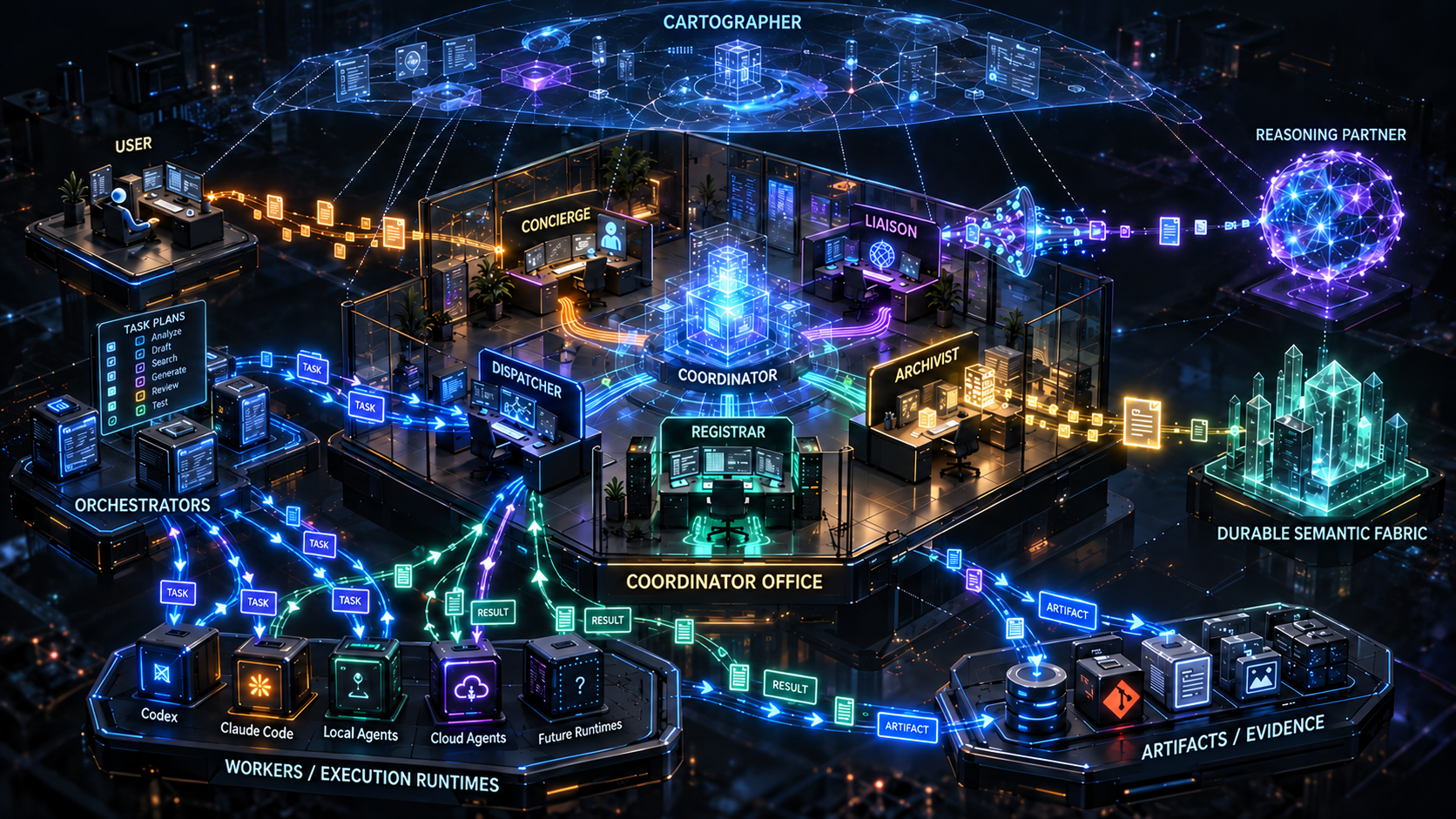
Conceptual Coordinator Office illustration.
The experiment described here concerns the Liaison projection and the Codex execution path.
Experiment
The relevant serialized Coordinator state measured 45,687 bytes; the Liaison projection measured 2,985 bytes.
The bounded workflow completed these steps:
- Liaison successfully requested work using the projection.
- Dispatcher handled assignment separately.
- Real Codex executed through Registrar.
- The completed result was retrieved successfully.
Result
The 2,985-byte projection represented a 93.47% reduction from the 45,687 bytes of relevant serialized Coordinator state.
The end-to-end workflow completed without requiring a hidden-field escape hatch or falling back to hidden operational state.
This is a result for the specific experiment, not a general model performance result.
Why it is interesting
The result suggests a useful design question: can context be treated as an interface, with boundaries shaped by the responsibility of each role?
Separating a request for work from assignment and execution gives us a concrete way to investigate that question.
The interesting observation is that the workflow completed through the projection, not merely that the serialized representation was smaller.
Limitations
This was one bounded system experiment, not evidence that 93% context reduction will generalize across tasks, models, or architectures.
- The experiment was bounded and deterministic.
- The 93.47% figure describes serialized bytes, not a measured reduction in tokens, latency, or cost.
- The result does not establish general model performance or production readiness.
- No broader reliability claim follows from this single completed workflow.
What we are exploring next
We want to investigate how role-specific projections behave across different tasks, how they should represent missing information, and where a narrow interface needs to expand.
These are questions for further experiments, not conclusions from this one.